

Kazakhstan-Russia: Full text of the Declaration.12.11. 2025.
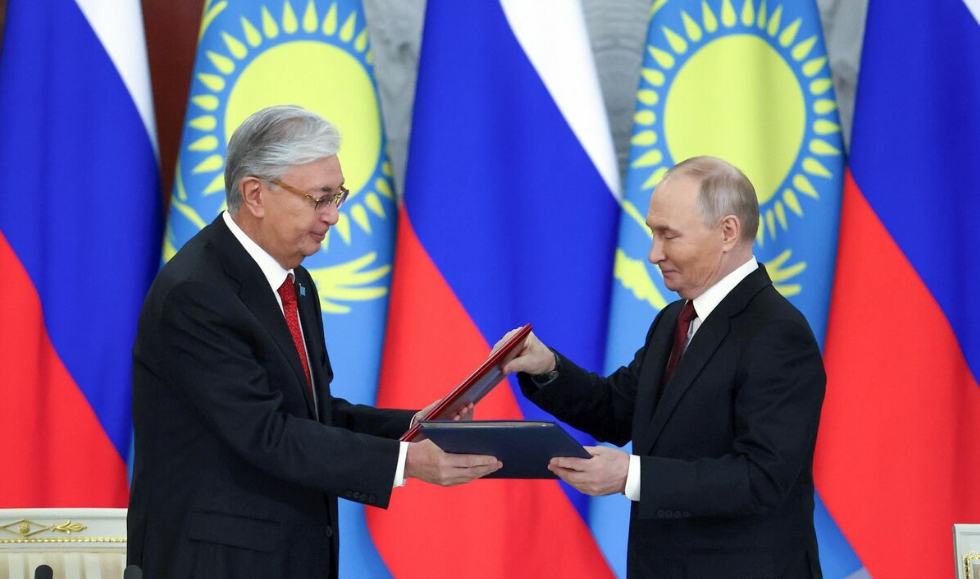
The Russian Federation and the Republic of Kazakhstan, following the first state visit of the President of the Republic of Kazakhstan Kassym-Jomart Tokayev to the Russian Federation on November 12, 2025,
acting in strict accordance with the provisions of the Treaty of Friendship, Cooperation, and Mutual Assistance between the Russian Federation and the Republic of Kazakhstan of May 25, 1992, the Declaration between the Russian Federation and the Republic of Kazakhstan on Eternal Friendship and Alliance Oriented to the 21st Century of July 6, 1998, and the Treaty between the Russian Federation and the Republic of Kazakhstan on Good-Neighborliness and Alliance in the 21st Century of November 11, 2013,
Based on the long-term objectives of the Joint Statement of the President of the Russian Federation and the President of the Republic of Kazakhstan on the 10th Anniversary of the Signing of the Treaty between the Russian Federation and the Republic of Kazakhstan on Good-Neighborliness and Alliance in the 21st Century of November 9, 2023, and the Joint Statement of the President of the Russian Federation and the President of the Republic of Kazakhstan on Deepening Strategic Partnership in the Context of the New Global Order of November 27, 2024,
Emphasizing the special atmosphere of mutual understanding, equality, and trust inherent in the Russian-Kazakh dialogue,
Reaffirming the inviolability of centuries-old friendship and alliance based on mutual assistance and respect for a common history, sovereignty and territorial integrity, independent domestic and foreign policies, and cultural identity,
Declaring our determination to support each other in the face of global challenges and threats, as well as in countering any attempts at domestic political destabilization,
Welcoming the consistently high dynamics of practical cooperation in the political, economic, humanitarian, defense, and security spheres,
In the interests of further developing the entire range of multifaceted bilateral relations and cooperation in a multilateral format, elevating them to a higher level in the name of the prosperity and peaceful future of both states, strengthening security and stability in our common region and in Eurasia as a whole,
PROCLAIME the establishment between them of a comprehensive strategic partnership within the framework of allied relations, the content of which presupposes the following:
I. In the Sphere of Politics and Security
1. The Parties will maintain high-level political contacts at all levels, a trusting dialogue between leaders of state, heads of government, and heads of central and regional government bodies, and intensive interparliamentary and public ties to ensure the integrity of the privileged relations between the Russian Federation and the Republic of Kazakhstan.
2. The Parties remain committed to the goal of building a more representative and equitable multipolar world order based on respect for international law, including all the purposes and principles enshrined in the Charter of the United Nations (UN).
3. The Parties will closely cooperate in the interests of sustainable international security, based on the premise that ensuring the security of states and their associations should not be carried out to the detriment of the security of others. The fundamental interests of the Parties are served by the formation of a reliable architecture of equal and indivisible security on the Eurasian continent. Its system-forming elements include the Collective Security Treaty Organization (CSTO), the Commonwealth of Independent States (CIS), the Shanghai Cooperation Organization, and the Conference on Interaction and Confidence-Building Measures in Asia.
4. The Parties reaffirm the key role of the CSTO in maintaining regional stability and emphasize their commitment to further strengthening the potential of this Organization, including within the framework of the upcoming Russian Federation Chairmanship in 2026. The Parties will contribute to improving the CSTO crisis response mechanisms, increasing the combat readiness of the forces and means of the collective security system, and deepening cooperation in the fight against modern challenges and threats.
5. The Parties recognize that there is no alternative to strengthening the regime of the Treaty on the Non-Proliferation of Nuclear Weapons of July 1, 1968, and will undertake coordinated efforts to ensure the integrity and sustainability of the Treaty and prevent its use to suit opportunistic interests. The Parties also reaffirmed their conviction that internationally recognized nuclear-weapon-free zones strengthen international and regional peace and security and enhance the regime of this Treaty. In this context, the Parties noted the significant role of the Treaty on a Nuclear-Weapon-Free Zone in Central Asia of September 8, 2006 (Treaty of Semipalatinsk), which is the only such zone in the Northern Hemisphere.
6. The Parties intend to develop cooperation in the field of biological security, including within the framework of the Coordinating Council of Authorized Bodies of the CSTO Member States on Biological Security Issues, and to provide mutual support to initiatives to strengthen the regime of the Convention on the Prohibition of the Development, Production and Stockpiling of Bacteriological (Biological) and Toxin Weapons and on their Destruction.
7. The Parties intend to deepen cooperation in the field of international information security; emphasize the key role of the UN in discussing international information security issues; welcome the agreement to establish at the UN in 2026 a global mechanism for developments in the field of information and communication technologies in the context of international security and the promotion of responsible behavior of states in the use of information and communication technologies; emphasize the need to develop, within the framework of this mechanism, universal legally binding norms in the field of international information security; call for efforts to ensure the early entry into force of the UN Convention against Cybercrime of 24 December 2024, as well as to improve mechanisms for combating information crime by developing an additional protocol to the said Convention; consider unacceptable attempts to use information and communication technologies to interfere in the internal affairs of states, as well as for sabotage and terrorist purposes; support the central role of the UN in discussing the topic of artificial intelligence, with an emphasis on ensuring sovereignty and compliance with national legislation by developers of such technologies.
8. The Parties remain committed to the principles of cooperation among the Caspian states, as set forth in the Convention on the Legal Status of the Caspian Sea of 12 August 2018, including the non-presence of armed forces in the Caspian Sea that do not belong to the Parties, non-impairment of each other's security, non-accession by Caspian states of their territories to other states for aggression or other military actions against any of the Parties, as well as the use of the Caspian Sea for peaceful purposes and the resolution of all issues related to the Caspian Sea by peaceful means.
9. Taking into account the changing water level of the Caspian Sea, the Parties confirm their interest in cooperating to preserve its water resources with the participation of all Caspian states. The Parties attach great importance to the initiative of the Republic of Kazakhstan to develop a corresponding interstate program of the Caspian states.
10. The parties welcomed the establishment in the Republic of Kazakhstan of the UN Regional Centre for Sustainable Development Goals for Central Asia and Afghanistan as a promising platform for promoting mutually beneficial, long-term and region-wide sustainable development projects.
11. The Parties will continue to work together to prevent the placement of weapons in outer space and the threat or use of force against outer space objects, as well as to advance the initiative to adopt a political commitment not to be the first to place weapons in outer space.
II. In the area of economic cooperation and integration
12. The Parties are prepared to work together on issues of aligning integration processes in the Eurasian space, including the liberalization of trade relations between their participants, the joint development of transport and logistics infrastructure, and other issues of economic cooperation, including within the framework of the Greater Eurasian Partnership.
Noting the growing international authority of the Eurasian Economic Union, the Parties will continue to develop common markets in accordance with the Treaty on the Eurasian Economic Union of May 29, 2014, and jointly address the challenges of increasing the competitiveness of national economies, including within the framework of the Republic of Kazakhstan's chairmanship of the Union in 2026.
The Parties view the CIS as an important integration platform for broad cooperation. They support the development and deepening of interaction within the Commonwealth and express their readiness to further work together to strengthen its potential as an authoritative international organization making a significant contribution to global and regional cooperation.
13. The Parties will more fully realize the potential of trade, economic, industrial, energy, financial, and infrastructure cooperation, as well as agricultural and food cooperation; continue to diversify the trade structure, adapt it to modern geopolitical conditions, remove excessive barriers to the movement of goods and services in mutual trade and transit, build a seamless transport and logistics space, digitalize their economies, improve technical regulation, and identify new sectors for cooperation.
14. The Parties will consistently enhance cooperation in the area of export control, guided by the objective of achieving an optimal balance between the development of international trade and measures aimed at maintaining peace and security.
15. Taking into account the world's longest continuous land border between the Russian Federation and the Republic of Kazakhstan, the Parties will use interregional and cross-border cooperation as a unique tool for strengthening interstate relations.
16. In light of the 20th anniversary of the Treaty between the Russian Federation and the Republic of Kazakhstan on the Russian-Kazakh State Border of 18 January 2005, celebrated this year, the Parties emphasize the fundamental and deeply symbolic significance of this document in the context of mutual trust and respect for the sovereignty and territorial integrity of both states.
17. The Parties will further strengthen financial cooperation, including through efforts to expand the use of national currencies in mutual settlements and develop payment infrastructures.
18. The Parties confirm that international obligations regarding the immunities of states and their property, including sovereign reserves, must be strictly observed.
19. The Parties recognize the importance of developing stable international transport corridors that are not subject to political pressures, and of modernizing and expanding logistics infrastructure that ensures economic sovereignty.
The parties confirmed that one of the key areas of cooperation is the creation of a unified Eurasian transport and logistics framework, which will strengthen regional connectivity and diversify cargo flows through more efficient, reliable, and secure supply chains.
Efforts to increase the capacity of the International North-South Transport Corridor and connect it with other transport arteries in the region will be of particular importance.
To strengthen transport connectivity between the Russian Federation and the Republic of Kazakhstan, the Parties will continue cooperation on the development of new and the modernization of existing international transport corridors, in particular the Western Europe-Western China route. Particular attention will also be paid to improving cross-border logistics infrastructure, including the reconstruction and improvement of checkpoints on the Russian-Kazakh state border using modern digital solutions. The parties will also interact within the framework of the Trans-Altai Dialogue initiative, aimed at developing the potential of the Eurasian "Altai" region.
20. The Parties will continue to strengthen their partnership in the energy sector, including the production, transportation, and supply of oil and petroleum products, natural gas, coal, and electricity. In order to ensure the economic and energy security of the Russian Federation and the Republic of Kazakhstan, the Parties will continue to create conditions for the unimpeded transportation of energy resources, the implementation of joint energy projects, including in the exploration and development of new fields, and improving the energy efficiency of their economies.
21. Particular attention is paid to developing cooperation in the gas sector, including issues of gas transportation to third countries, as well as ensuring reliable protection of critical cross-border energy infrastructure.
The parties emphasized the importance of the timely and high-quality implementation of the gas supply project to the northern and eastern regions of the Republic of Kazakhstan as one of the priority areas of bilateral cooperation.
The parties support the uninterrupted and sustainable operation of the Caspian Pipeline Consortium, which plays a key role in ensuring energy stability and developing economic cooperation in the region.
22. The parties recognize the importance of continuing cooperation in healthcare, professional training and advanced training of medical and pharmaceutical workers, enhancing scientific activity, including the use of artificial intelligence, developing the medical and pharmaceutical industries, and improving the organization of medical care.
III. In Advanced Science-Intensive Industries
23. The Parties are committed to socio-economic development with low greenhouse gas emissions and the promotion of fair and balanced energy transitions. The right to a diversified energy mix, utilizing all energy sources (fossil fuels, renewable energy, hydropower, nuclear, and hydrogen energy), will be consistently upheld, based on the understanding that the process of reducing greenhouse gas emissions must be carried out taking into account the specific circumstances of each country, its natural and climatic characteristics, and national interests, including in the area of socio-economic development. The principles of technological neutrality, non-discriminatory access to international funding sources, and the unimpeded transfer of energy technologies on mutually beneficial terms remain paramount.
In this context, the Russian Federation will act as a reliable partner in the creation of a national nuclear energy industry in the Republic of Kazakhstan and will fully fulfill its obligations as the leader of the international consortium for the construction of the first nuclear power plant in the Republic of Kazakhstan.
24. The Parties intend to strengthen cooperation in environmental protection and sustainable natural resource management, paying due attention to bilateral agreements and international treaties to which they are parties.
In order to preserve the unique natural ecosystems of the border areas of the Russian Federation and the Republic of Kazakhstan, joint activities will be continued on the sustainable management of transboundary water bodies, the development of a system of transboundary specially protected natural areas, the conservation of biodiversity, and the prevention and mitigation of the risks of natural disasters.
25. The Parties will continue practical cooperation in the area of critical raw materials necessary for the energy transition, based on the development of international production and supply chains.
26. As part of harmonious interaction based on national strategies for the development of the digital sphere, the Parties will exchange best practices in the digitalization of public administration, customs, and tax administration.
27. The Russian Side views positively the initiative of the Republic of Kazakhstan to establish a center for digital solutions for sustainable development under the auspices of the United Nations Economic and Social Commission for Asia and the Pacific and is prepared to work together with the Kazakh Side on this platform to agree on mutually beneficial parameters for the establishment and mandate of this center, as well as on subsequent activities.
28. In commemoration of the 70th anniversary of the Baikonur Cosmodrome, whose contribution to the scientific and technological progress of mankind is difficult to overestimate, the Parties intend to develop long-term cooperation at this facility for the purposes of exploring and peacefully using outer space and creating a national space program for the Republic of Kazakhstan.
IV. In the Humanitarian Sphere
29. In light of the celebration of the 80th anniversary of Victory in the Great Patriotic War, the Parties will jointly study the historical facts about the events of that time and the heroic contribution of the peoples of the USSR to saving the world from Nazism.
The Parties note the key role of the education system in shaping future generations' objective understanding of their shared past. An objective attitude toward our shared history and the protection of our descendants from wars is the sacred duty of our peoples.
30. The Parties will continue to encourage interaction between historians, archivists, search parties, volunteer and youth movements, within the framework of the joint working group of historians of Russia and Kazakhstan, the International Association (Commission) of Historians and Archivists of the CIS Member States, and other bilateral and multilateral platforms.
31. The Parties reaffirmed their commitment to further improving the conditions of stay of citizens of the two countries in each other's territories, noting the importance of constructive cooperation in the area of migration.
32. Welcoming the establishment of the International Russian Language Organization, the Parties will facilitate its activities and call on all interested states to do so.
The Parties will facilitate the maintenance and promotion of the Russian language as a means of interstate communication within the CIS.
33. The Parties will continue close cooperation in education and personnel training and will steadily develop scientific dialogue.
34. Cultural and humanitarian ties are a unique asset that will continue to grow based on the Parties' respect for the cultural diversity of the modern world. On this foundation, dialogue will be encouraged in every possible way, allowing for a deeper understanding of the past, traditions and culture of the two fraternal peoples, promoting their mutual enrichment on the basis of close spiritual and moral values, the civilizational unity of the Slavs and Turks, the brotherhood of “ancient Rus' and the Great Steppe”, and the union of Orthodoxy and traditional Islam.
35. The Parties welcome the opening of the Alley of Eternal Friendship between Russia and Kazakhstan in Astana and the Russia-Kazakhstan Friendship Square in Moscow, which symbolize the mutual commitment to the friendly and allied future of the two states and peoples.
36. Exchanges will continue between museums, libraries, theaters, art galleries, and other cultural institutions, as well as between representatives of creative professions, literary and artistic associations, and filmmakers. The positive role of international cultural, educational, scientific, and youth forums and festivals, as well as joint sporting events, which make a significant contribution to direct human interaction, is noted.
37. The Parties welcome the cooperation carried out within the framework of the implementation of the Agreement between the Government of the Russian Federation and the Government of the Republic of Kazakhstan on the establishment and conditions of operation of information and cultural centers of October 12, 1998.
38. The Parties consider the politicization of international humanitarian cooperation and discrimination against cultural, scientific, and athletic figures on any basis to be unacceptable. The Parties will jointly advocate for the development of an open and respectful intercultural dialogue that excludes discrimination.
39. The Parties confirm their interest in establishing Russian-Kazakh and Kazakh-Russian general education organizations (schools) in the regions of the Russian Federation and the Republic of Kazakhstan, taking into account the educational standards of both countries.
40. The Parties welcome the opening of a branch of Al-Farabi Kazakh National University in Omsk and a branch of the Moscow State Institute of International Relations (University) in Astana as a step aimed at strengthening educational ties.
41. The Parties support the holding of the International Multisport Tournament "Future Games" in the Republic of Kazakhstan as a platform for combining sports, technology, and youth interaction.
42. The Parties highly appreciate the holding of the Days of Kazakhstan Culture in Russia in Moscow and intend to continue implementing this format of cultural interaction.
President of the Russian Federation V.V. Putin and President of the Republic of Kazakhstan Kassym-Jomart Tokayev share the firm conviction that the implementation of the aforementioned forward-looking goals and objectives will become an unshakable foundation for friendship and cooperation between the two fraternal peoples in the interests of further strengthening the comprehensive strategic partnership and allied relations between the Russian Federation and the Republic of Kazakhstan.