


Saudi Arabia and Pakistan signed a joint defense pact
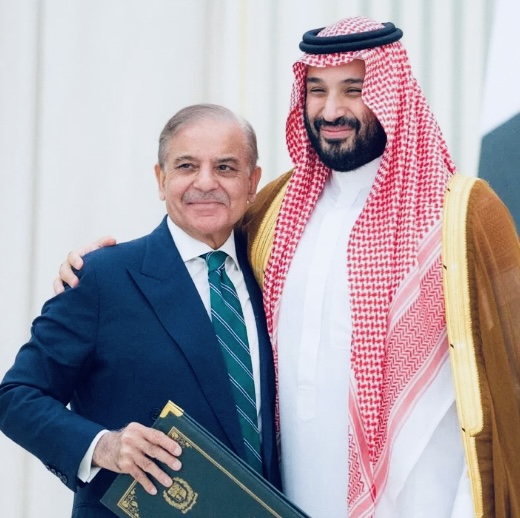
The Middle East witnessed a rare display of unity and cooperation: following the September 14th emergency Arab-Islamic summit to discuss the creation of an Arab military alliance, on September 17th, Saudi Arabia and Pakistan signed a joint defense pact, stipulating that any attack on either country will be considered an attack on both.
This news undoubtedly attracted worldwide attention, as Pakistan is the only nuclear power in the Islamic world. The question is widely being asked: does this mean Pakistan will provide Saudi Arabia with a "nuclear umbrella?" An unnamed Saudi official responded: "This is a comprehensive defense agreement, covering all military capabilities."
How should such an evasive response be interpreted? How will military cooperation between Middle Eastern countries develop in the future? Will this become a new opportunity for Chinese arms exports? Guancha contacted Sun Degang (孙德刚), director of the Center for Middle East Studies at Fudan University and an expert on Middle East affairs, and asked him to analyze the impact of the signing of the new agreement and military cooperation in the region on the situation in the Middle East based on his long-term observation of the region.
Guancha: The Pakistani and Saudi Arabian militaries have long cooperated closely; the Pakistani army even provided security for the Saudi royal family. However, this agreement undoubtedly deepens and formalizes this cooperation. This raises the question: will Pakistan extend its "nuclear umbrella" to Saudi Arabia? And is Pakistan capable of providing a "nuclear umbrella" to other countries?
Sun Degang: The two sides undoubtedly signed a joint defense agreement, but its provisions only clearly state that "an attack on one side is considered an attack on the other." As for whether Pakistan will provide a "nuclear umbrella" to Saudi Arabia, it's difficult to say at this point; it's too early to draw any definitive conclusions.
I believe the likelihood of providing a "nuclear umbrella" is currently low. If this were to happen, it would require the deployment of Pakistani troops and air defense systems to Saudi Arabia, which would greatly complicate the technical and operational aspects. Moreover, the United States remains Saudi Arabia's primary security partner. Will the United States agree to a rapprochement between Saudi Arabia and Pakistan on these issues? Most likely not. Saudi Arabia cannot sideline the United States and ask Pakistan to provide a "nuclear umbrella." Until the United States agrees, operational steps will be virtually impossible.
Second, the question of timing: when will Pakistan be able to provide Saudi Arabia with a "nuclear umbrella"? This is only possible when Saudi Arabia truly faces a nuclear threat.
Third, the question of capabilities: does Pakistan have such capabilities? We know that Pakistan and Saudi Arabia are separated by Iran and the Persian Gulf; they are not geographically connected. Given this geographical structure, how can Pakistan provide Saudi Arabia with a feasible and reliable "nuclear umbrella"? How realistic is this? Uncertainty remains high.
Guancha: We know that over the past decades, Saudi Arabia and Iran have waged continuous proxy wars for dominance in the region. And recently, Israel struck Qatar, a well-known negotiating venue in the Middle East, with missiles launched from aircraft. What do you believe were the main factors that influenced the signing of this agreement between Saudi Arabia and Pakistan? Although Mohammed bin Salman recently met with the Iranian president, and Iran was undoubtedly prepared for such a development, does Iran really not have its own opinion on such strategic cooperation?
Sun Degang: The Saudi-Pakistani signing of a joint defense agreement stems from geopolitical changes in the Gulf region. Previously, the GCC countries (Saudi Arabia, the UAE, Qatar, and others) believed that following the US in security and "looking East" economically would allow them to maintain neutrality and remain an "oasis of peace" in the unstable Middle East. But now this seems impossible.
The fact that Qatar was struck twice in June and September was a wake-up call for Saudi Arabia: even following the US or remaining neutral does not guarantee security, demonstrating the unreliability of American guarantees.
Therefore, the signing of the defense agreement by Saudi Arabia and Pakistan is essentially aimed at diversifying their defense, rather than relying solely on the US.
A more immediate reason, I believe, is protection from possible Israeli actions. Netanyahu stated: "Whoever 'harbors' Hamas and other similar organizations will become the target of Israeli strikes, including possible new strikes on Qatar."
This made Saudi Arabia feel threatened, so the agreement is more of a preventative measure against the threat from Israel.
From Iran's perspective, the signing of a new mutual defense agreement between Saudi Arabia and Pakistan is a good thing. Saudi Arabia and Pakistan are Islamic countries, and their joint defense will help weaken US influence and, in practice, limit Israel, which Iran generally welcomes.
Iran, of course, prefers cooperation in a multilateral format rather than excluding Iran from it. It has always advocated for the advancement of the "Strait of Hormuz Peace Initiative," seeking to create a regional cooperation community involving Pakistan, the six GCC countries, Iran, and Iraq. In this regard, the "over-Iranian diplomacy" between Saudi Arabia and Pakistan has been somewhat disappointing for Tehran. However, overall, strengthening defense cooperation between Saudi Arabia and Pakistan does not harm Iran and even serves its interests.
Guancha: Before the signing of the agreement between Saudi Arabia and Pakistan, an Extraordinary Arab-Islamic Summit was held in Doha, Qatar, to discuss the response to the Israeli strikes on Doha. According to media reports, the summit discussed the creation of an Arab military alliance to counter the Israeli military threat—the most significant step toward regional military integration in decades. In your opinion, how likely is the formation of this Arab military alliance? You also mentioned the American factor. Does this mean that Middle Eastern countries have realized they can no longer rely on the US for security and are beginning to move toward autonomy and regional unity? Is the Middle East security system that the US is trying to build facing new challenges?
Sun Degang: In fact, since the 1980s, the GCC and the Arab League have repeatedly proposed the idea of a "united Arab army," and after 9/11, an "Arab anti-terrorism coalition," but ultimately, all these initiatives remained on paper. Neither the GCC nor the Arab League have succeeded in integrating the military forces of several countries into a single organization. The issue is who will lead this "Arab NATO" and how many troops and resources each country will contribute—the differences on these issues are too great.
The formation of an Arab military alliance depends on further developments in the Middle East. If the situation continues to deteriorate and Israel begins to strike other Arab/Islamic countries, the states may accelerate military integration. The first step in implementation would likely be the creation of a lightweight mechanism, such as a "rapid reaction force." However, for now, this remains at the conceptual level, and its actual implementation depends on further developments.
But its significance lies in breaking the US "monopoly" on Middle East security matters. Previously, the US provided a "protective umbrella" to its Arab allies, but now there are numerous examples of Americans failing to fulfill their obligations. For example, in 2019, when the Houthis attacked Saudi Arabian refineries, temporarily cutting national oil production capacity by half, the US did nothing; this year, when Qatar was attacked twice, the US provided no support.
As conflicts in the Middle East intensify and spread, Arab and Islamic countries are increasingly seeking strategic autonomy. Will they achieve this? This will depend on how the situation develops.
Guancha: Israel has long tried to suppress countries that could threaten its security; the recent strike on Qatar is undoubtedly a show of force. But if Saudi Arabia truly gains a "nuclear umbrella" from Pakistan, will Israel's security deteriorate? Israel has already begun to struggle against Turkey's expanding influence; What will be his reaction to the cooperation between Saudi Arabia and Pakistan?
Sun Degang: The Middle East is experiencing a new redistribution of power.
Before the conflict between Israel and Palestine in October 2023, the United States actively promoted the Abraham Accords to unite Israel and Arab countries in an anti-Iranian front, and at the global level, to expel non-Western powers such as China and Russia from the Middle East.
But reality shows that the Israeli and US policy of "security through strength," even offensive realism, has gradually led many Arab countries to realize that the immediate threat currently emanates not from Iran, but from Israel.
Thus, we see that the Arab-Islamic world, at least at the political and diplomatic levels, has already formed a kind of "anti-Israel front." Previously, the GCC countries, together with the US and Israel, contained Iran; Currently, the GCC is, on the one hand, developing strategic cooperation with Iran and Turkey, and on the other, strengthening interaction with Pakistan, gradually forming an Islamic united front.
In this new structure, Israel finds itself in a disadvantageous position. Expecting that aggressive realism would bring greater security, it has had the opposite effect, pushing the GCC countries, and even Jordan and Egypt, in the opposite direction. Objectively, Israel has become the new "glue" holding the Arab countries together with Pakistan, Iran, and even Turkey in a united Islamic world.
Going forward, Israel will likely cling even more tightly to the United States: using Washington to pressure its Arab allies to prevent their distancing and attempting to "convince or coerce" them to remain on its side.
Guancha: Do you think the Abraham Accords can still be advanced?
Sun Degang: This seems impossible now. The Abraham Accords were initially a key initiative of Trump's second term, aimed at normalizing relations between Saudi Arabia and Israel, which would encourage more Arab states to recognize Israel. But with the escalating conflict in Gaza and the growing humanitarian crisis there, as well as Israel's persistent refusal to recognize an independent Palestinian state and the construction of new Jewish settlements in the West Bank, anti-Israeli and anti-Semitic sentiment in Arab countries has intensified. Any Arab leader must take public opinion into account, so the Abraham Accords are unlikely to advance anytime soon.
Guancha: It is well known that while Saudi Arabia's primary military hardware remains predominantly European and American, the country has long shown an interest in Chinese weapons. Pakistan is China's primary arms export client. After the Israeli strike on Qatar, how will cooperation between Saudi Arabia and Pakistan impact Chinese arms exports and security influence?
Sun Degang: Overall, the opportunities outweigh the challenges. China has advanced initiatives in global governance, global development, global civilization, and global security, providing important "public goods" to Middle Eastern countries. At the same time, the US monopoly on arms supplies in the Persian Gulf has been broken, and more and more GCC and Arab countries are diversifying their arms purchases, not relying solely on the US but choosing multiple suppliers, which benefits China.
However, reducing dependence on the US does not mean exclusively relying on Chinese weapons. The Middle East has a wide range of weapons: in addition to the US and China, Turkey, Europe, and even India are represented. The future will likely bring a diversified or multipolar arms supply system. The US share will decline, but remain significant. For China, this is a new market with significant opportunities.
Guancha: Given that Middle Eastern countries' primary need is security, do you think their demand for Chinese security assistance or protection will increase? I previously spoke with a former Pakistani official who expressed hope for Chinese troop deployment in the region. China currently has no plans to send troops there. Given the growing calls for such action, what actions do you expect?
Sun Degang: Next year, the second China-Arab Arab Summit will take place, scheduled to be hosted by China. This means that the Arab countries' "look East" is no longer limited to economics; in this new environment, they are also diversifying their activities in the political sphere and even in the security sphere.
For China, this presents an opportunity to strengthen its community of shared destiny with Arab countries by leveraging the "Four Initiatives" to modernize governance in the Middle East. Given the current instability and uncertainty, China has great potential in this area. We can deepen the community of shared destiny with Arab countries, bringing greater stability and predictability to the region.
While China has previously focused more on development in the region, this approach will become more diversified in the future. The community of shared destiny between China and Arab countries will take on a deeper meaning, and defense cooperation will become a new area of growth.
In recent years, China has been actively developing defense cooperation with Egypt, Oman, and other countries; in the future, such "hubs" will increase, particularly in the areas of military training, joint exercises, military visits, and military diplomacy. China does not plan to establish new military bases in the Middle East, but will respond to the needs of Arab countries: developing energy, economic, trade, and scientific-technical cooperation, as well as turning security cooperation into a new growth area and a new field of activity.